When Overwatch 2 first unveiled Ramattra in November 2022, the community erupted with a mix of awe and dread. The omnic tank’s gameplay trailer revealed a bruiser who could seamlessly switch between a defensive staff-wielding form and a hulking, fisted Nemesis mode. It didn’t take long for players to draw a line connecting him to the game’s most beleaguered hero at the time, Doomfist. The prevailing sentiment was as blunt as a freight train: Ramattra was everything Doomfist wished he could be—and then some. Fast-forward to 2026, and that early gut feeling has aged like fine wine. Ramattra hasn’t just left a mark on the meta; he’s fundamentally redefined what a frontline tank can achieve, while Doomfist has become the poster child for missed potential.
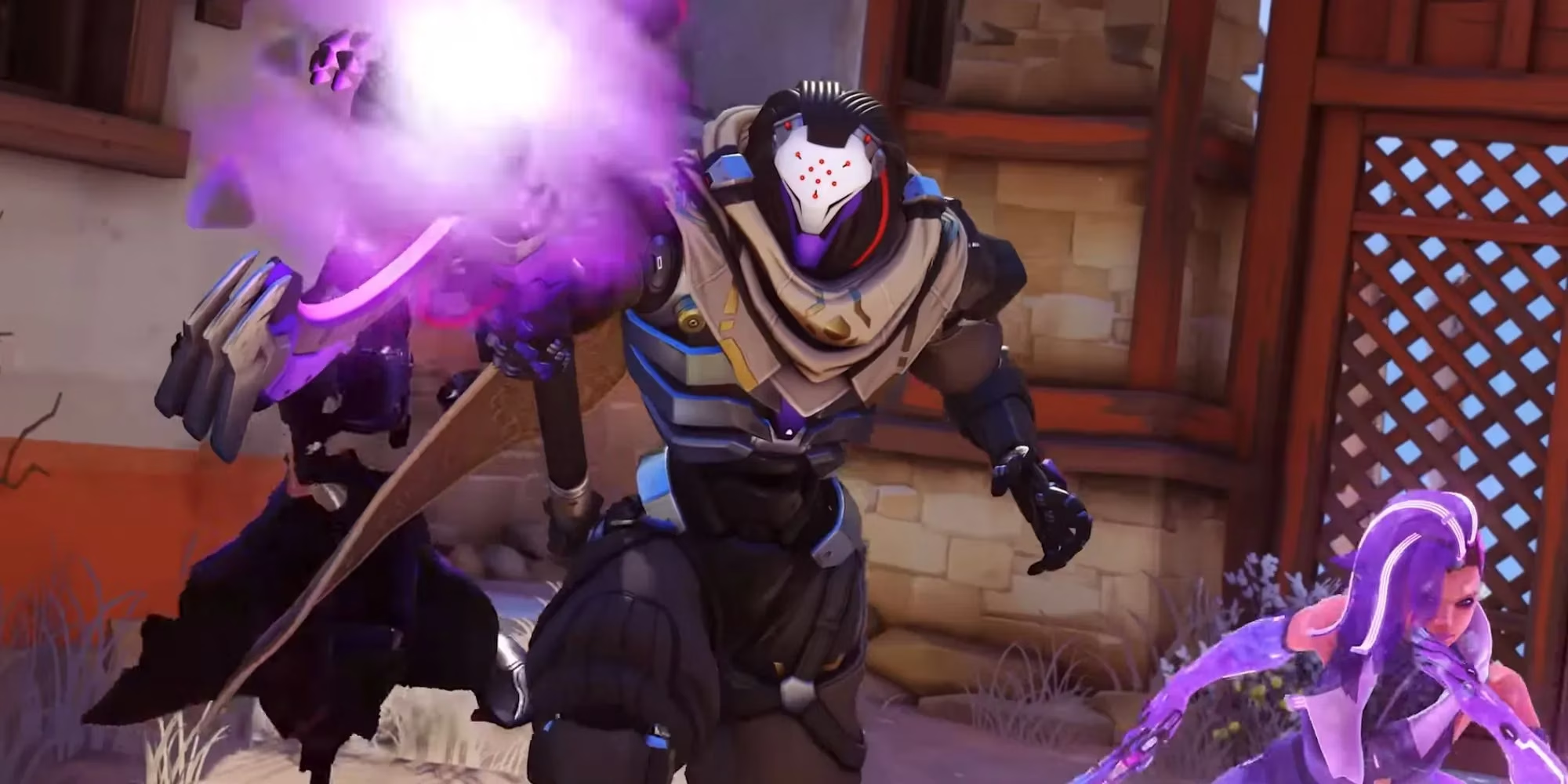
The initial comparisons were no kitchen-sink hot take. Ramattra’s Pummel ability in Nemesis form delivered a rapid series of concussive punches that pierced barriers and knocked enemies back, inherently reminiscent of Doomfist’s Rocket Punch. Yet, where Doomfist left himself exposed after a single lunging strike, Ramattra’s Block during Pummel soaked up damage from the front, giving him a protective layer that Doomfist could only dream of. The omnic could also toss a Void Barrier to shield his team, much like old Orisa, and his Annihilation ultimate drained enemy health while pumping damage into the surrounding melee. As Reddit user Nowayman1414 put it back then, “Jesus, it’s everything Doomfist wished he was.” Even dedicated Doomfist mains felt the floor crumbling beneath them. User ElderSkyrim mourned, “As a Doomfist player, I might want to reconsider my choice of main.” The writing was on the wall: Doomfist had been handed a big, fat, robotic L.
Not everyone bought the doom-and-gloom forecast, mind you. A vocal minority argued that Ramattra’s kit owed more to a bygone version of Orisa—slow, deliberate, with a deployable shield—than to the hyper-mobile Doomfist. Mobility, after all, was Doomfist’s trump card, letting him zip across maps and disrupt back lines with guerrilla-style hit-and-run. Ramattra, they pointed out, was a lumbering presence who relied on cooldowns and positioning rather than raw agility. Still, anyone who’d endured a clueless Doomfist diving headfirst into a 1v5 on Illios could vouch for the fact that mobility without purpose was just fancy thumb-twiddling. Ramattra, by contrast, brought consistent damage mitigation and area control to the table—things that actually helped the team hold a point.
December 6, 2022 arrived, and Ramattra slotted into the game with immediate impact. Sure, unlocking him required grinding to tier 55 of the paid battle pass, which left a sour taste for free-to-play users, but the character himself delivered on the hype. In the weeks that followed, the meta began to crystallize around tanks that could enforce a clear tempo. Ramattra’s dual-form playstyle—poking from range, then morphing into a close-quarters juggernaut—became a blueprint for how tanks should control space. Doomfist, on the other hand, languished. His block ability was a poor man’s version of damage reduction, and his power charge mechanic often left him dangling in the wind. By early 2023, Blizzard attempted several buffs to pull Doomfist out of the gutter, but each patch seemed to miss the mark by a country mile.
As 2023 rolled into 2024, the conversation shifted. Players began to accept that Doomfist wasn’t just underpowered—he was fundamentally designed for a different era of Overwatch. The fluid, brawling pace that Ramattra and subsequent tanks (like the heavily reworked Roadhog in late 2024) encouraged didn’t suit a one-trick dive hero. By mid-2025, with the introduction of the perk system and global passive tweaks, Ramattra had evolved into a stable pick across all ranks, while Doomfist’s win rate flatlined at the bottom of the tank roster. The phrase “just pick Ramattra” became a meme in competitive lobbies, a cheeky way of telling a Doomfist one-trick to stop throwing.
In the present day, 2026, Ramattra’s legacy is impossible to ignore. He stands as one of Overwatch 2’s most balanced yet impactful tanks, having undergone only mild adjustments—a tweaked Particle Barrier cooldown here, a slight Pummel damage nerf there. The hero’s ability to shift between passive and aggressive postures has inspired a whole generation of tank designs. Heroes like Gaia, released in Season 18, borrowed heavily from this “stance-swap” philosophy. Meanwhile, Doomfist remains a niche pick, beloved by a tiny, stubborn fanbase but largely written off by the competitive scene. Blizzard hasn’t officially given up on him, but the community long ago internalized the lesson that a high-skill floor shouldn’t translate to a low-skill payoff. It’s a hard pill to swallow for the few remaining Doomfist faithful, but the meta has spoken—and it speaks in the modulated, Omnics-are-the-future voice of Ramattra.
The silver lining? Doomfist did receive a minor rework in the 2025 anniversary patch that gave him a passive shield generation on eliminations, making him somewhat more survivable. Yet, when you compare his clunky combos to the seamless brutality of Ramattra’s Nemesis form, the gap remains a mile wide. As one player reflected on the forums, “It’s like Blizzard built the perfect tank first, then forgot to go back and update the old one.” Whether by accident or design, Ramattra set the gold standard for what a tank should feel like in Overwatch 2. And for Doomfist, that standard has been nothing short of a life sentence in the lower tier.
Comments