The world of competitive gaming has just witnessed a seismic shift. Blizzard Entertainment, the powerhouse behind one of the most iconic esports leagues, has delivered a final, decisive blow to the Overwatch League (OWL), officially announcing its closure. This marks the end of an era for a pioneering franchise that, since its dazzling debut, captivated millions of players and spectators globally. Accompanying this somber news is Blizzard's declaration of pivoting towards a "new direction" for Overwatch 2 esports, leaving the community in a state of reflection and anticipation for what comes next.
🏆 The Rise and Reign of a Pioneering League
Launched with immense fanfare in late 2016, the Overwatch League kicked off its inaugural season in January 2018, fundamentally altering the esports landscape. It wasn't just another tournament; it was a revolutionary, city-based franchise model. Teams like the Shanghai Dragons, Seoul Dynasty, and San Francisco Shock weren't just esports squads—they were hometown heroes, fostering deep, immersive connections with fans across continents. This innovative structure, combined with Blizzard's signature high production values, electrifying commentary, and jaw-dropping player skill, propelled the OWL to the zenith of global esports. It became a cultural phenomenon, a weekly spectacle that blended the intensity of professional sports with the dynamic, colorful world of Overwatch.
⚖️ The Cracks Begin to Show: The Road to Closure
Despite its glorious inception, the league's journey wasn't without turbulence. Rumblings of instability grew louder throughout 2023. Key moments included:
-
July 2023 Whispers: Initial reports surfaced hinting at a potential conclusion for the league, sending shockwaves through the community.
-
The Fateful Vote: Activision Blizzard approached all 20 franchise teams with a critical proposal regarding the future of Overwatch 2 esports, which included a vote on whether to continue the Overwatch League in its current form.
-
Official Confirmation (October 2023): As reported by major outlets, an Activision Blizzard spokesperson confirmed the company was actively "transitioning away from the Overwatch League." The statement expressed profound gratitude to everyone—players, coaches, staff, and fans—who contributed to the league's legacy while teasing a rebuilt competitive vision.
💰 The Staggering Financial Fallout
This monumental decision carries a colossal price tag. Recent analyses suggest that shutting down the Overwatch League could cost Microsoft—which completed its acquisition of Activision Blizzard—over $100 million. This figure underscores the sheer scale and financial commitment the league represented. The fallout isn't just emotional for fans; it's a significant financial recalibration for the gaming giant.
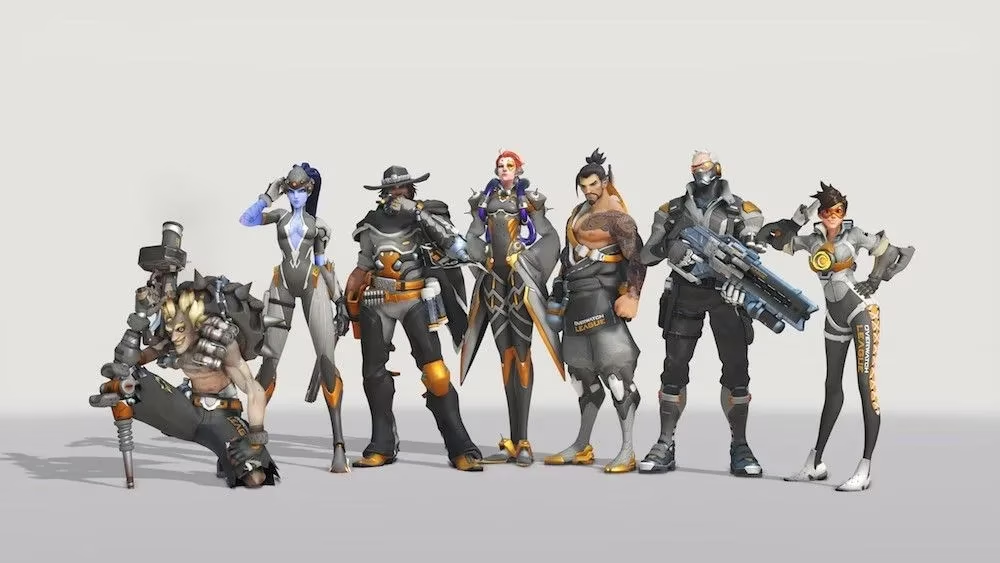
🔮 What's Next? The Promise of a "New Direction"
So, what does Blizzard's "new direction" entail? While specific details remain under wraps, the industry is already buzzing with clues and collaborations:
-
Partnership with ESL FACEIT Group (EFG): Activision Blizzard staff are finalizing a contract with the esports powerhouse ESL FACEIT Group to oversee and manage the competitive scene for Overwatch 2 in 2024 and beyond. This signals a likely shift from a proprietary, closed franchise system to a more open, tournament-based ecosystem that EFG is renowned for.
-
A Community-Centric Model? The future may involve a structure that is more accessible to amateur and semi-pro players, potentially featuring open qualifiers, third-party tournaments, and a circuit that rewards consistent performance over franchise buy-ins.
-
Focus on Overwatch 2: All efforts are now concentrated on building a sustainable esports program around the free-to-play Overwatch 2, leveraging its updated heroes, maps, and gameplay dynamics.
😢 A Legacy Remembered: What the OWL Meant to Esports
The closure of the Overwatch League leaves a void. It was more than a competition; it was a proof-of-concept for city-based esports, a source of incredible storylines (like the Shanghai Dragons' perfect season redemption), and a career launchpad for countless professional players. Its end represents a significant loss for the dedicated Overwatch community and the broader esports world, which watched it push the boundaries of production and presentation.
| Era | Key Feature | Impact |
|---|---|---|
| 2018-2020 (Peak) | City-Based Franchises, Homestand Events | Created localized fanbases & elevated production standards. |
| 2021-2023 (Transition) | Online Adaptations, OW2 Integration | Navigated global challenges while evolving with the new game. |
| 2024+ (Future) | Partnership with EFG, Open Ecosystem | Aims for sustainability & broader competitive access. |
👋 Final Thoughts: An End and a Beginning
As we move further into 2026, the dust is settling on the Overwatch League's remarkable run. Its conclusion is a poignant moment, reminding us of the volatile nature of the esports industry. Yet, within this ending lies the seed of a new beginning. Blizzard's partnership with ESL FACEIT Group hints at a potentially more vibrant, accessible, and sustainable competitive future for Overwatch 2. While we say goodbye to the OWL as we knew it, the spirit of competition it fostered is far from over. The next chapter for Overwatch esports is being written, and the global community will be watching, controllers and keyboards at the ready, to see what heroics come next. 🎮✨
Comments